GHOST 3.9
Discounted price for professionals — Free B2B quote within 24h
Category: LED Screen Indoor
Pitch : 3.9 mm
Product images
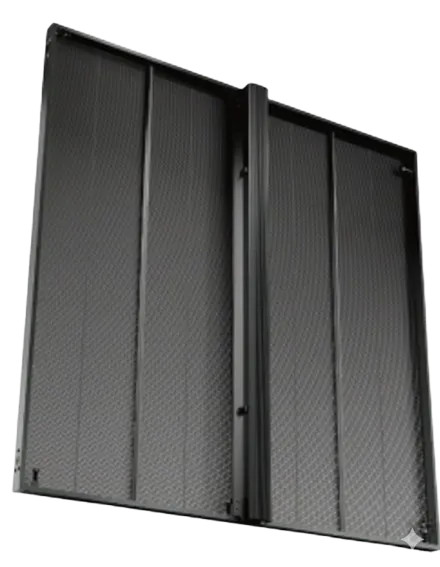

Description
The GHOST 3.9 is the reference panel of the transparent LED wall: 3.9 mm pitch, one-metre by one-metre cabinet, 50 % transparency. Unlike the GLASSTEC posters, which stand and travel, this one builds a continuous surface — on a glazed facade, in front of a glass roof, as an atrium drop.
The actual pitch is 3.90625 mm, 250 divided by 64. Each panel therefore carries exactly 256 × 256 pixels, and density lands squarely on 65,536 pixels per square metre. Across a ten-metre wall, layout calculations carry no rounding drift.
Fifty per cent: the balance point
One square millimetre in two lets light through. It is the setting that keeps both promises at once: the image reads in daylight, and you still see the facade through it. Below — the GHOST 3.4 at 45 %, the GHOST 2.6 at 40 % — the screen starts to read as a solid surface from outside. Above, the GHOST 2.8 – 5.6 at 60 % and the GHOST 3.9 – 7.8 at 75 % clearly favour see-through.
Distances
The grid stops being perceptible from 6.7 metres, fine detail is fully resolved at 13.4 metres. That is the distance of a facade seen from across the street, an atrium from ground level, a glass roof from the pavement.
Construction
SMD1415 LEDs, 500 × 62.5 mm modules, aluminium frame, front maintenance — decisive on a glazed facade, where the rear is often unreachable. 16 scan, 3,840 Hz refresh, 140° / 140° angle, 4,500 nits, 10 kg per panel, consumption 240 W/m² average against an 800 W/m² peak, operating range −20 to +60 °C.
What ten kilos per square metre change
A conventional LED wall weighs between 25 and 40 kg/m². At ten kilos, a GHOST 3.9 fixes to the mullions of an existing curtain wall without structural strengthening in most cases. It is often that figure, more than transparency, that makes the project feasible on an already-built building.
Technical Expertise
Avec un pitch de 3.9 mm, GHOST 3.9 couvre les distances de vision moyennes (3 à 8 m). Conçu pour un usage indoor, ce module combine 4500 nits et 3840 Hz, soit l'ensemble des paramètres attendus sur une installation B2B professionnelle.
Use Cases
Curtain wall and office building — fixed to existing mullions, ten kilos per square metre, with no structural strengthening in most cases. This is the panel's central use.
Glass roof and shopping centre atrium — read from ground floor and walkways, between seven and twenty metres, without darkening the light well.
Multi-level flagship window — continuous surface built across the full height of the glazing, with maintenance reachable from the front from street level.
Airport hall, station, corporate headquarters — information display on a glazed wall that must stay see-through for wayfinding.
Mediatecture and night-time building skin — the screen disappears by day and becomes the building's luminous skin in the evening, provided distinct night content has been planned.
Technical Tips
Confirm front maintenance before approving the layout. On a facade the rear is unreachable: a module that can only be changed from behind takes the wall out of service.
Budget access equipment as an operating cost, not just an installation one. Over the lifetime, access costs exceed part costs.
Plan distinct night content, not merely dimmed content. In the evening the relationship reverses: the screen is seen from inside, against a dark street.
Size the electrics on 800 W/m², read the bill on 240. The gap between peak and average is a factor of three on facade content.
An all-in-one covers up to 99 m². At 65,536 pixels per m², a VX1000 Pro handles almost every existing transparent facade.
Calculate in 3.90625 mm. Across ten metres of facade, rounding to 3.9 loses six pixels of alignment.
Do not go below seven metres of viewing distance. Below that the grid shows, and transparency does not compensate.
Technical Specifications
| Specification | Value |
|---|---|
| Pitch | 3.9 mm |
| Brightness | 4500 nits |
| Refresh Rate | 3840 Hz |
| Module Size | 500 x 62,5 mm |
| Panel Resolution | 256 x 256 |
| Dimensions (W×H×D) | 1000×1000×? mm |
| Panel Weight | 10 kg |
| LED Type | SMD1415 |
| Viewing Angle | 140°/140° |
| LED Lifespan | 100 000 heures |
| Color Temperature | 6500k |
| Operating Temperature | -20 °C à +60 °C, 10 % à 90 % HR |
Frequently Asked Questions
À quelle distance peut-on regarder un écran LED pitch 3.9mm ?
La distance de visionnage optimale pour un pitch de 3.9mm commence à environ 4 mètres. À cette distance, l'œil humain ne distingue plus les pixels individuels, offrant une image fluide et parfaitement nette pour votre audience.
Quels sont les avantages d'un écran LED intérieur ?
Un écran LED indoor comme le GHOST 3.9 offre une luminosité supérieure aux écrans LCD classiques et une absence totale de bordures. Cela permet de créer des surfaces d'affichage géantes et sur-mesure avec un contraste saisissant, même en environnement très éclairé.
Comment installer un écran LED géant GHOST 3.9 ?
L'installation peut se faire de manière fixe au mur, sur une structure autoportante ou suspendue par des barres de levage (flybars). Les modules GHOST 3.9 sont conçus pour un assemblage rapide et sécurisé grâce à un système de verrouillage précis.
Quelle est la durée de vie d'un écran LED professionnel ?
Les composants LED de haute qualité utilisés par PIXELIGHT garantissent une durée de vie allant jusqu'à 100 000 heures de fonctionnement. Un entretien régulier et une configuration thermique optimale permettent de maximiser cette longévité sur plus de 20 ans à raison de 12 heures d'utilisation par jour (environ 11 ans en fonctionnement continu 24 h/24).
Quel prix pour un écran LED pitch 3.9mm ?
Le tarif d'une solution LED dépend de la surface totale, du type de structure et du processeur vidéo choisi. Contactez PIXELIGHT pour obtenir un devis personnalisé et une étude technique adaptée à votre projet d'affichage dynamique.