Novastar MCTRL700 | Contrôleur d'Envoi LED 6 Ports Gigabit
Discounted price for professionals — Free B2B quote within 24h
Category: LED Screen Processeur vidéo LED
Product images

Description
NovaStar MCTRL700 — six Gigabit ports and video cascading
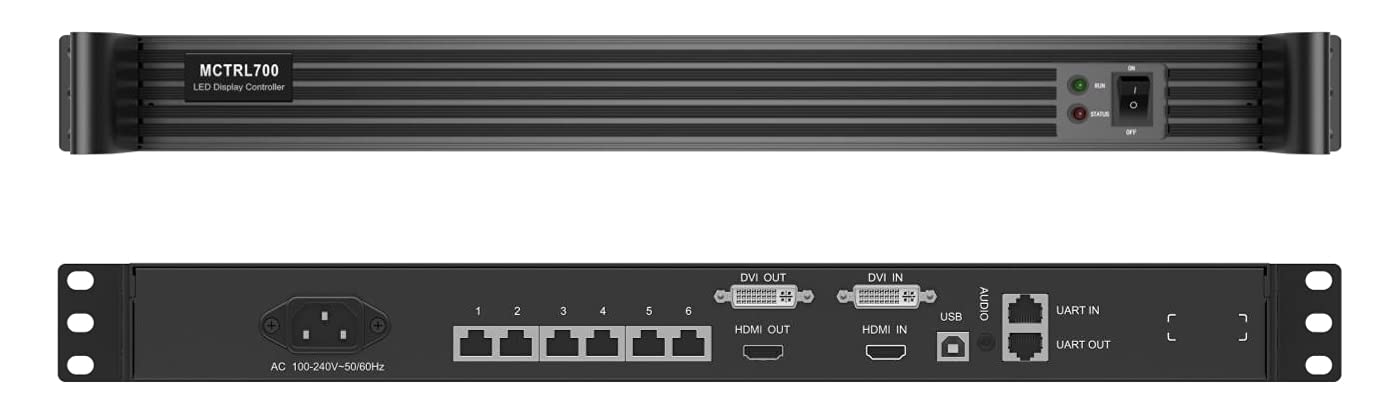
The MCTRL700 carries exactly the same capacity as the MCTRL600 — 1920 × 1200 at 60 Hz, 650,000 pixels per port — and adds two things that change site topology: six Gigabit Ethernet ports instead of four, and above all a DVI output and an HDMI output dedicated to video cascading.
That loop-out relays the video signal from one controller to the next without an external splitter. On a multi-controller install, that is one box fewer in the rack and one failure point fewer. NovaStar updated its datasheet in November 2024: it is still a supported product, extended since 2025 by an MCTRL700 Pro version.
Key specifications
Load: 1920 × 1200 @ 60 Hz (8-bit) — 1440 × 900 @ 60 Hz (12-bit)
Network outputs: 6 × Gigabit RJ45, 650,000 px per port
Inputs: 1 × single-link DVI, 1 × HDMI 1.3, 1 × audio
Video outputs: 1 × DVI OUT, 1 × HDMI OUT (cascade)
Chassis: 1U 19", 482 × 268.5 × 44.4 mm, 2.6 kg
Power: AC 100–240 V, 12 W
Certifications: FCC, CE, RoHS, IC
Technical Expertise
NovaStar MCTRL700 — technical analysis
The misunderstanding to clear first: the six ports do not increase pixel capacity. Like the MCTRL600, it is capped by its video input at 1920 × 1200, that is 2,304,000 pixels. The "6 × 650,000 = 3.9 million" calculation circulates widely and is wrong: it is an Ethernet-side bandwidth ceiling, unreachable for lack of a wide enough input.
What the six ports actually bring is topology flexibility: the same load spreads across more links, so shorter cabinet chains, simpler cabling on a wide wall, and easier redundancy. On a 40-cabinet wall, the difference between four and six ports shows in cabling time and chain length, not in displayable pixels.
Against the MCTRL600 the trade-off is three lines: the 700 brings six ports and the video loop-out; the 600 brings the light sensor connector, absent from the 700 datasheet. For a fixed install that must regulate its own brightness, the 600 remains the right pick. For a wide wall or a multi-controller rack, the 700.
Like the 600 it offers no Genlock, no HDR, no documented low-latency mode, and it drives MRV and Armor cards under NovaLCT — not COEX 5G cards.
Use Cases
- Wide fixed-installation walls — six ports to shorten cabinet chains.
- Multi-controller racks — DVI OUT / HDMI OUT cascading avoids an external distributor.
- Events and rental — 1U chassis, cascade up to 20 units.
- Conference rooms and auditoriums — 1080p source, distributed cabling.
- Estate maintenance — replacement on installations already running an MCTRL700.
Technical Tips
- Real capacity — 2,304,000 pixels, same as the MCTRL600. The six ports do not add up.
- Video loop-out — DVI OUT and HDMI OUT relay the signal to the next controller: one splitter fewer in the rack.
- No light sensor — not documented on the 700 datasheet; if automatic regulation is required, take the MCTRL600.
- Topology — six ports means shorter chains and simpler redundancy, not more pixels.
- Not COEX-compatible — MRV and Armor cards under NovaLCT only.
Technical Specifications
| Specification | Value |
|---|---|
| Loading capacity | 1920×1200@60Hz en 8 bit — 1440×900@60Hz en 12 bit. Largeur max 3840 px, hauteur max 3840 px. 650 000 pixels par port Ethernet. |
| Dimensions (W×H×D) | 482×269×44 mm |
| Panel Weight | 2.6 kg |
| Max Power | 12 W |
| LED Lifespan | Env. 100 000 heures |
| Color Temperature | 6500k |
| Operating Temperature | -20 °C à +60 °C |