Novastar XA50 Pro
Discounted price for professionals — Free B2B quote within 24h
Category: LED Screen Carte de Réception
Product images

Description
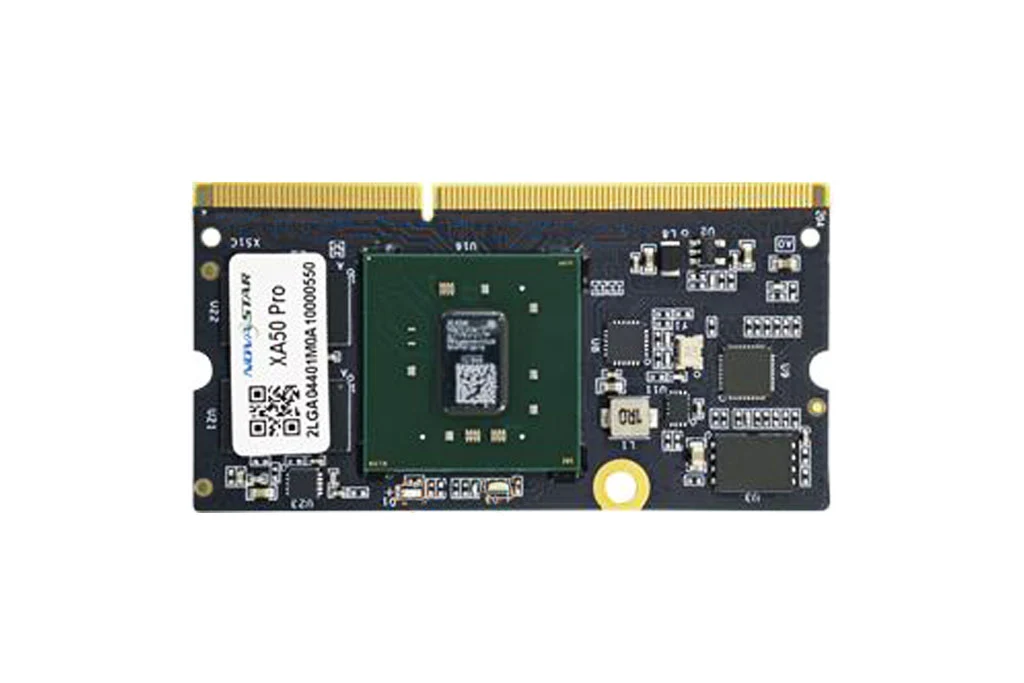
NovaStar XA50 Pro — the densest 5G card in the COEX range
The XA50 Pro is the receiving card NovaStar currently features in its 5G range. It drives 1024 × 512 pixels at 60 Hz in both 8-bit and 10-bit and 620 × 512 in 12-bit — a third more pixels than the CA50E, in a form factor half the size and at 5 W instead of 6.8 W.
It is not a JH-connector card but a mini board with a 204-pin DDR3-type connector that plugs into the cabinet backplane: the network arrives through the backplane, not an on-board RJ45. That form factor is what lets NovaStar claim one card per cabinet on P0.9 and P0.6.
Key specifications
Load: 1024 × 512 @ 60 Hz (8 and 10-bit) / 620 × 512 @ 60 Hz (12-bit)
Bandwidth: 5G
Data: 40 parallel RGB groups or 64 serial groups, LVDS supported
Connector: 204-pin DDR3 type
Dimensions: 67.6 × 35.0 × 4.3 mm
Weight: 10.4 g
Power: DC 3.8 – 5.5 V, 1 A, 5 W
Certifications: RoHS, EMC Class A
Technical Expertise
NovaStar XA50 Pro — technical analysis
The XA50 Pro is chosen on one criterion: one card per cabinet. On P0.9 as on P0.6, a standard cabinet fits within 1024 × 512 pixels. Moving from two or three cards per cabinet to one changes hardware cost, internal cabling, the number of failure points and service time. That is an engineering argument as much as a price one.
Image processing is NovaStar's top tier: Image Booster 2.0 (Rec.709 / DCI-P3 / Rec.2020), Precise Grayscale at 65,536 levels (16-bit), 22bit+, Brightness Overdrive, HDR10 compliant with SMPTE ST 2084 and ST 2086, HLG, Frame Rate Adaptive 3.0 from 23 to 240 Hz, multi-layer full-grayscale calibration with the C3200 camera, adaptive thermal compensation and one-frame latency.
The design point not to miss: the official datasheet requires a heatsink larger than 250 × 250 × 3 mm. On a fine-pitch cabinet already tight on depth, that dissipation area is planned on the drawing, not afterwards. It is the constraint that derails poorly prepared integrations.
Use Cases
- P0.9 and P0.6 fine-pitch cabinets — one card per cabinet, the target NovaStar states.
- XR studios and virtual production — full-load 10-bit, up to 240 Hz.
- High-end broadcast — ST 2084 / ST 2086 compliant HDR10 and multi-layer calibration.
- Fine-pitch control rooms — maximum density with the fewest cards.
- Cabinet manufacturing — a card to design in, on the backplane.
Technical Tips
- Heat dissipation — a heatsink larger than 250 × 250 × 3 mm is required by the official datasheet: design it into the cabinet.
- Form factor — 204-pin DDR3-type backplane connector: not a drop-in for a JH-connector card.
- One card per cabinet — confirm the cabinet resolution fits within 1024 × 512 before finalising the quote.
- 5G chain — COEX 5G controller and VMP required; incompatible with a Gigabit estate under NovaLCT.
- 12-bit — the load drops to 620 × 512: recalculate card count if the project demands 12-bit.
Technical Specifications
| Specification | Value |
|---|---|
| Loading capacity | Sources 8 bit et 10 bit : 1024×512@60Hz — Sources 12 bit : 620×512@60Hz. 40 groupes de données RGB parallèle ou 64 groupes série. |
| Dimensions (W×H×D) | 68×35×5 mm |
| Max Power | 5 W |
| LED Lifespan | Env. 100 000 heures |
| Color Temperature | 6500k |
| Operating Temperature | -20 °C à +70 °C |