Novastar MRV532
Discounted price for professionals — Free B2B quote within 24h
Category: LED Screen Indoor
Product images

Description
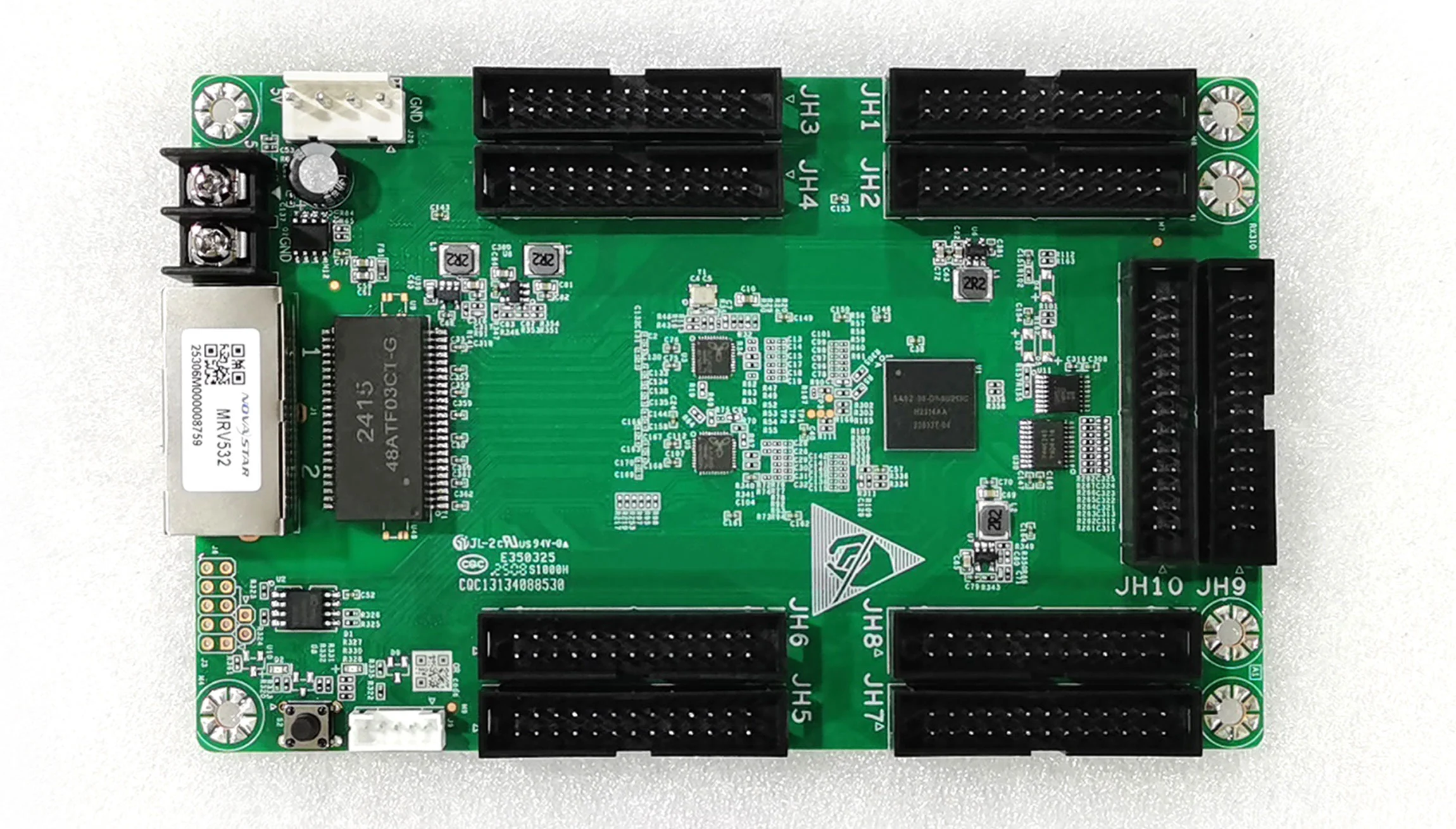
The Novastar MRV532 is a high-performance indoor receiving card designed for high-density LED display applications requiring superior data throughput. As the flagship of the MRV series, it distinguishes itself by utilizing ten HUB320F connectors instead of the standard HUB75E interface, allowing it to manage up to 40 groups of parallel RGB data. This increased data capacity makes it the premier choice for fine-pitch displays utilizing dynamic sub-pixel technologies (3-LED or 4-LED). Engineered for professional environments, the MRV532 supports HDR10 standards (SMPTE ST 2084/2086) and features advanced 18bit+ grayscale enhancement to ensure smooth gradients and exceptional contrast ratios. With its robust build and specialized connectivity, it provides the stability and processing power needed for high-resolution indoor video walls where color accuracy and low latency are critical.
Technical Expertise
Expert Engineering for Fine-Pitch LED Integration
As a technical leader in the LED industry, Pixelight recognizes the Novastar MRV532 as a pivotal component for modern SMD and GOB (Glue-on-Board) displays. The transition to HUB320F connectors is a technical necessity for high-density layouts, enabling efficient addressing of dynamic sub-pixels which significantly enhances perceived resolution without increasing physical pitch.
Superior Processing and Refresh Rates
The MRV532 is optimized for high-refresh-rate performance. When paired with PWM driver ICs, it supports a loading capacity of 512×512 pixels at 60Hz for 8-bit sources. For high-bit-depth workflows, it handles 512×256 pixels for 10-bit and 12-bit sources, ensuring fluid motion and flicker-free broadcasting. It is the only card in the MRV lineup to explicitly document HDR10 support, providing professional-grade color management compatible with Rec.709, DCI-P3, and Rec.2020 color gamuts.
- 18bit+ Grayscale: Improves display performance under low brightness, maintaining detail in dark scenes.
- Pixel-Level Calibration: Supports both brightness and chromaticity calibration for uniform visual output across the entire surface.
- Low Latency: Reduces delay to a single frame, essential for live events and interactive setups.
- Reliability: Features dual-card and dual-power redundancy support for mission-critical installations.
Use Cases
Versatile Applications for High-End Visuals
The Novastar MRV532 is engineered for indoor environments where visual precision is paramount. Its advanced feature set makes it suitable for a wide range of professional installations:
- Control Rooms & Command Centers: High-bit-depth support and 18bit+ grayscale ensure that data visualizations and surveillance feeds are crisp and legible.
- Broadcast Studios: High refresh rates prevent moiré patterns and flickering when captured by professional cameras, while HDR10 provides lifelike color reproduction.
- Retail & Corporate Lobby Displays: Ideal for GOB-protected fine-pitch screens in high-traffic areas requiring vivid colors and wide viewing angles.
- Virtual Production & XR: Low latency and precise color management (Rec.2020) are essential for synchronizing LED volumes with camera movements.
- Rental & Staging: Robust cascading via Gigabit Ethernet ports allows for flexible configurations in concert touring or corporate events.
Technical Tips
Technical Integration and Configuration Advice
When designing your LED system with the MRV532, it is crucial to account for the updated loading capacity specifications found in the latest V1.1.2 firmware documentation. Previous versions suggested higher capacities for 10-bit sources; however, current standards mandate a limit of 512×256 pixels to ensure signal integrity and refresh rate stability.
- Connectivity: Ensure your module transition boards are compatible with the HUB320F interface to leverage the full 40 groups of RGB data.
- Power Management: The card operates between 3.8V and 5.5V DC. Maintain a stable power supply to prevent voltage drops that could affect the PWM driver performance.
- Viewing Distance: Use this card primarily for fine-pitch indoor cabinets where pixel density requires high-speed data processing to maintain a wide viewing angle and high contrast.
- Maintenance: Utilize the "Mapping" function for rapid cabinet identification during setup and troubleshooting.
Technical Specifications
| Specification | Value |
|---|---|
| Loading capacity | Driver PWM : 512×512@60Hz (8 bits), 512×256@60Hz (10 et 12 bits) — Driver commun : 512×512@60Hz (8 bits), valeur 10/12 bits non publiée. Scan maximal 64. |
| LED Lifespan | Env. 100 000 heures |
| Color Temperature | 6500k |
| Operating Temperature | -10°C-+50°C |
Frequently Asked Questions
À quelle distance peut-on regarder un écran LED équipé de la Novastar MRV532 ?
La distance de recul dépend du pitch des modules LED connectés à la carte ; elle se calcule généralement en multipliant le pitch par 1 mètre pour un confort visuel optimal.
Quelle est la capacité de charge de la MRV532 selon la profondeur de bits ?
Selon la fiche V1.1.2 du 20 mars 2025 : avec des drivers PWM, 512×512@60Hz sur sources 8 bits et 512×256@60Hz sur sources 10 et 12 bits ; avec des drivers communs, 512×512@60Hz sur sources 8 bits, aucune valeur 10/12 bits n'étant publiée pour ce cas. Attention : la fiche précédente, V1.0.2 de mai 2024, indiquait 512×384@60Hz en 10 et 12 bits. C'est cette valeur qui a été révisée.
Quels sont les avantages d'un écran LED intérieur avec cette carte ?
L'usage de la MRV532 permet une gestion fluide de 40 groupes de données RGB, garantissant une image stable, des couleurs précises et une compatibilité avec les résolutions élevées en intérieur.
Pourquoi la MRV532 utilise-t-elle des connecteurs HUB320F et non HUB75E ?
Parce que le HUB320F transporte davantage de données par port. C'est ce qui permet à la carte d'adresser jusqu'à 40 groupes de données RGB en pixels réels, 40 groupes en sous-pixel dynamique 3 LED ou 30 groupes en 4 LED. Sur les pas fins, la densité de points à piloter sature un port HUB75E bien avant que la surface en mètres carrés ne devienne le facteur limitant. En contrepartie, vos modules doivent être compatibles HUB320F.
Comment installer un écran LED géant Novastar MRV532 ?
L'installation nécessite la connexion des modules LED via les 10 connecteurs HUB320F, suivie d'une configuration logicielle via NovaLCT pour calibrer les pixels et le mapping.
Quelle est la durée de vie d'un écran LED professionnel ?
Un écran LED de qualité professionnelle a une durée de vie moyenne de 100 000 heures, sous réserve d'un entretien régulier des composants comme la carte de réception MRV532.
La MRV532 est-elle la seule carte MRV compatible HDR ?
C'est la seule dont la fiche de spécifications documente la prise en charge du HDR10, conforme aux normes SMPTE ST 2084 et SMPTE ST 2086. Les fiches V1.0.3 des MRV412-N et MRV416-N ne mentionnent pas le HDR, et la MRV208-1 ne dispose d'aucune fiche PDF distincte. Pour un projet HDR, la chaîne complète — source, contrôleur, cartes et modules — doit néanmoins être validée.
Faut-il choisir la MRV532 plutôt qu'une MRV416-N ?
Seulement si le projet le justifie techniquement. Sur du pas standard en grande surface, le HUB320F et le sous-pixel dynamique n'apportent rien de décisif et la MRV416-N couvre le besoin avec le même jeu de fonctions de traitement, hors HDR. La MRV532 se justifie sur trois déclencheurs : pas fin, adressage en sous-pixel dynamique, ou exigence HDR10 au cahier des charges.
Quel prix pour un écran LED avec Novastar MRV532 ?
Le tarif varie selon la surface totale et le pitch choisi. Contactez PIXELIGHT pour un devis personnalisé incluant l'intégration de cartes haut de gamme MRV532.