Novastar DH7516-S
Discounted price for professionals — Free B2B quote within 24h
Category: LED Screen Carte de Réception
Product images

Description
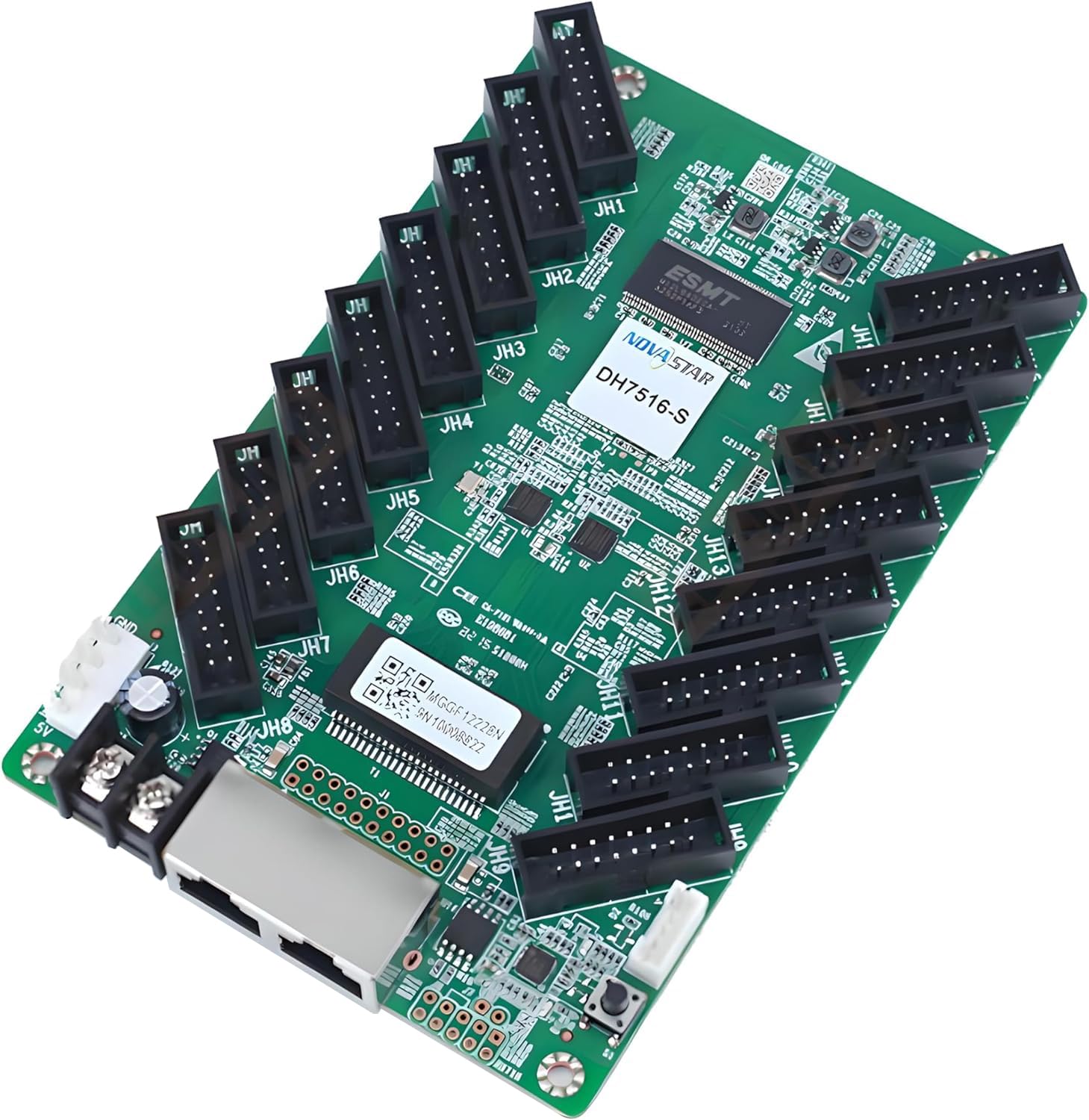
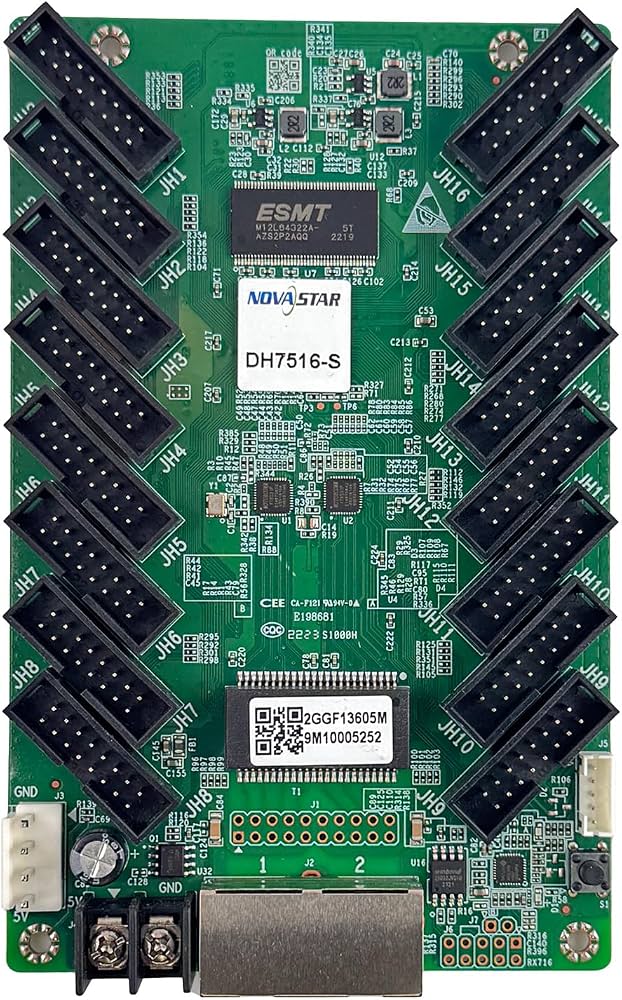
NovaStar DH7516-S — DH series receiving card
The DH7516-S belongs to the DH series, the entry level of NovaStar receiving cards. It drives 512x384 at 60Hz on a PWM driver and carries 16 HUB75E connectors, up to 32 parallel RGB groups. It is the card to choose when cost per square metre decides the job and the project requires neither HDR, nor low latency, nor extended bit depth.
Specifications
Load capacity: 512×384@60Hz avec driver IC PWM, 384×384@60Hz avec driver IC commun. Jusqu'à 32 groupes RGB parallèle.
Module connectors: 16 HUB75E connectors, up to 32 parallel RGB groups
Ethernet: Gigabit, each port usable as input or output
Dimensions: 145,7 × 91,5 × 18,3 mm (hors tout 19,0 mm) — Weight: 100,9 g
Power: DC 3.8 – 5.5 V, 0.5 A, 2.5 W
Temperature: −20 °C to +70 °C
Certifications: RoHS, EMC Class A
Technical Expertise
NovaStar DH7516-S — technical analysis
What the DH series keeps, and what it drops. It keeps everything that runs a wall day to day: pixel-level luminance and chroma calibration, quick dark and bright line adjustment, individual R/G/B gamma, 3D, 90-degree image rotation, Mapping 1.1, temperature and voltage monitoring, bit error detection, loop backup and dual program backup. What it drops against the MRV and Armor series: 18bit+, low latency and HDR, none of which any DH datasheet mentions.
A point of caution we would rather state: despite its sixteen connectors, the DH7516-S is capped at 512 × 384 on a PWM driver, less than the DH7508-S and DH7512-S which reach 512 × 512. Several resellers claim 512 × 512 for this reference: that is not confirmed by the official documentation we could verify, and we will not publish it. A more recent datasheet revision may have raised the figure — we have it confirmed by NovaStar for any project where the wall division depends on it.
The arbitration rule, in one line: DH suits fixed, commercial and advertising display; rule it out as soon as there is camera capture, a latency requirement, very low brightness or an HDR chain. On a 300-panel DOOH project, the price gap between a DH card and an Armor card, multiplied by the cabinet count, is often the margin on the deal.
Use Cases
- DOOH and advertising display — many cabinets, the card price decides.
- Fixed outdoor installation — signage, information, storefront.
- Street furniture — volume, standard pitch, no camera capture.
- Volume panel manufacturing — controlled cost at scale.
- High-density 16-module cabinets — 32 RGB groups
Technical Tips
- No HDR, no low latency, no 18bit+ — no DH datasheet mentions them: rule it out on broadcast or filmed projects.
- Driver IC — capacity drops with a common driver: 384x384 instead of 512x384.
- Connectors — 16 HUB75E connectors, up to 32 parallel RGB groups: check the exact match with your modules before ordering.
- Power — DC 3.8 V minimum: incompatible with older 3.3 V supplies.
- Trade-off — against an MRV416-N you lose 18bit+ and low latency, you gain on cost per cabinet.
Technical Specifications
| Specification | Value |
|---|---|
| Loading capacity | 512×384@60Hz avec driver IC PWM, 384×384@60Hz avec driver IC commun. Jusqu'à 32 groupes RGB parallèle. |
| Dimensions (W×H×D) | 146×92×19 mm |
| Max Power | 3 W |
| LED Lifespan | Env. 100 000 heures |
| Color Temperature | 6500k |
| Operating Temperature | -20 °C à +70 °C |